BCAA-Glo™ Assay
Fast, Sensitive BCAA Measurement Across Diverse Biological Sample Types
- Detect leucine, isoleucine and valine from cultured cells, media, tissue homogenates and serum
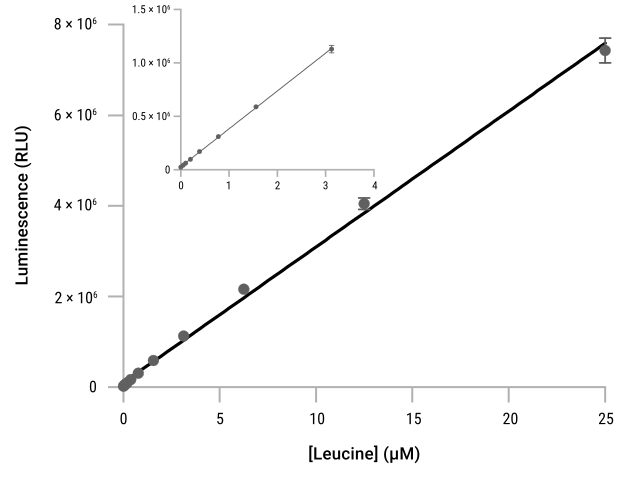
- Sensitive bioluminescent readout with a 50nM limit of detection and linear range of 50nM to 25µM
- Streamlined protocol—no cell collection, centrifugation or spin columns required
- Adaptable to 384-well format for high-throughput analysis

Catalog Number:
Size
Catalog Number: JE9300
Catalog Number: JE9400
Efficient BCAA Detection from Diverse Samples
The BCAA-Glo™ Assay is a fast and sensitive method for detecting branched-chain amino acids (BCAA; leucine, isoleucine and valine) from various biological samples, such as cultured cells, media, tissue homogenates and serum. Based on bioluminescent technology, the BCAA-Glo™ Assay can detect subtle changes in amino acid metabolism and abundance. Its streamlined sample preparation protocol involves acid treatment and neutralization directly in the assay wells, eliminating the need for cell collection, centrifugation and spin columns. The assay is adaptable to a 384-well format, facilitating quick analysis of many samples.
How the BCAA-Glo™ Assay Works
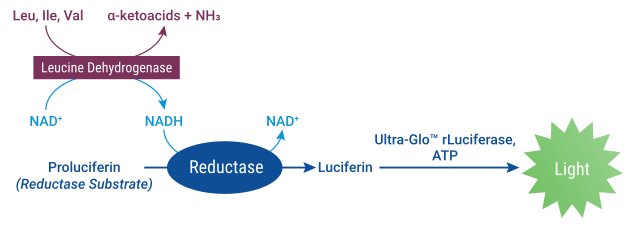
Leucine Dehydrogenase catalyzes the oxidation of BCAA, simultaneously reducing NAD+ to NADH. In the presence of NADH, Reductase converts the proluciferin Reductase Substrate into luciferin. This reaction is detected by Ultra-Glo™ Recombinant Luciferase, which emits light proportionate to the amount of BCAA in the sample.
Leucine Dehydrogenase recognizes all three BCAA with similar efficiency. It is specific for BCAA L-isomers.
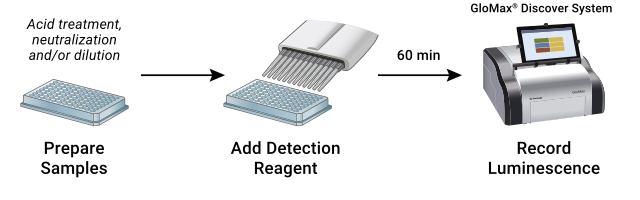
Simple Add-and-Read Protocol Saves Time
Accurately Detect the Smallest Changes in Branched-Chain Amino Acids
|
Sensitivity (S/B >5) |
400nM |
|
|
Limit of Detection (S/N >3) |
50nM |
|
|
Linear Range |
50nM to 25μM |
|
|
Maximum Assay Window (S/B) |
>300 |
|
Sensitive Quantitation of BCAA in Cultured Cells
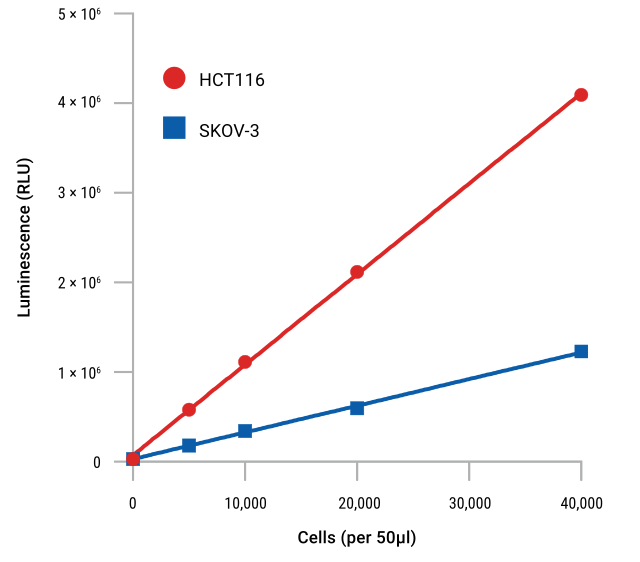
Cellular BCAA levels vary depending on cell type, growth conditions and metabolic activity. Intracellular BCAA concentrations are typically low. However, the BCAA-Glo™ Assay, with its high sensitivity and wide linear detection range, successfully measures BCAA levels in cell lysate samples ranging from 5,000 to 40,000 cells per 50μl, as shown in the graph.
Do you want to learn more about our cellular energy metabolism tools and the innovative technology that powers these assays?
Protocols
Complete Protocol
Specifications
Catalog Number:
Contenido
| Item | Part # | Presentación | Concentración |
|---|---|---|---|
Leucine Dehydrogenase |
J412A | 1 × 100μl | |
Leucine, 10mM |
J413A | 1 × 50μl | |
Reductase |
G884A | 1 × 55μl | 6mg/ml |
Reductase Substrate |
G885A | 1 × 55μl | |
Luciferin Detection Solution |
J135A | 1 × 5ml | |
NAD |
J136B | 1 × 275μl | |
Neutralization Buffer |
J153A | 1 × 15ml | |
NADP+ |
J154B | 1 × 100μl | |
0.6N HCl |
J402A | 1 × 15ml |
SDS
Search for SDSCertificado de Análisis
Use Restrictions
For Research Use Only. Not for Use in Diagnostic Procedures.U.S. Pat. Nos. 9,273,343 and 9,951,372, European Pat. No. 2751089, Japanese Pat. No. 6067019 and other patents pending.
Contenido
| Item | Part # | Presentación | Concentración |
|---|---|---|---|
Leucine Dehydrogenase |
J412B | 1 × 1ml | |
Leucine, 10mM |
J413A | 1 × 50μl | |
Reductase |
G884B | 1 × 275μl | 6mg/ml |
Reductase Substrate |
G885B | 1 × 275μl | |
Luciferin Detection Solution |
J135B | 1 × 50ml | |
NAD |
J136C | 1 × 1ml | |
Neutralization Buffer |
J153A | 1 × 15ml | |
NADP+ |
J154C | 1 × 500μl | |
0.6N HCl |
J402A | 1 × 15ml |
SDS
Search for SDSCertificado de Análisis
Use Restrictions
For Research Use Only. Not for Use in Diagnostic Procedures.U.S. Pat. Nos. 9,273,343 and 9,951,372, European Pat. No. 2751089, Japanese Pat. No. 6067019 and other patents pending.
Resources
Artículos
Posters
Related Products
Productos Similares
Glutamine/Glutamate-Glo™ Assay
Permite detectar glutamina y glutamato en muestras biológicas.
J8021, J8022
Glucose-Glo™ Assay
Detección de glucosa de forma sencilla en una amplia gama de muestras biológicas.
J6021, J6022
Triglyceride-Glo™ Assay
Detecta los niveles de triglicéridos midiendo el glicerol que se libera de una reacción enzimática con una lipasa.
J3160, J3161
Metabolite-Glo™ Detection System
Conjunto de herramientas de detección bioluminiscente de NAD(P)H para la detección de metabolitos en muestras biológicas.
J9030, J9040
Usado con frecuencia junto con
RealTime-Glo™ MT Cell Viability Assay
Método bioluminiscente que permite monitorizar la cinética de viabilidad de cultivos celulares durante 72 horas.
G9711, G9712, G9713
CellTiter-Fluor™ Cell Viability Assay
Ensayo de viabilidad celular fluorescente no lítico con capacidad multiplex.
G6080, G6081, G6082
CellTiter-Glo® 2.0 Cell Viability Assay
Versión actualizada del CellTiter-Glo® Cell Viability Assay con una estabilidad del reactivo mejorada. Cuantifica la proliferación celular basándose en la detección de ATP.
G9241, G9242, G9243
GloMax® Discover System
Lector de microplacas de alto rendimiento para la detección de luminiscencia, fluorescencia y absorbancia.
GM3000