Glutamine/Glutamate-Glo™ Assay

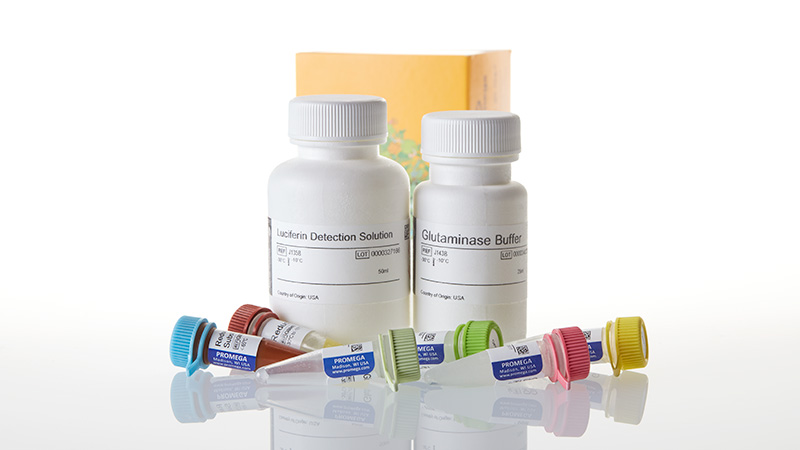
Sensitive, Quick Detection of Glutamine and Glutamate in Biological Samples
- Detect even small changes in metabolites
- Multiplex with other metabolite or viability assays
- Perform on a variety of sample types

Catalog Number:
Size
Catalog Number: J8021
Catalog Number: J8022
Quickly Detect Glutamine and Glutamate from Biological Samples
The Glutamine/Glutamate-Glo™ Assay is a bioluminescent assay for the rapid and sensitive measurement of glutamine and glutamate from a variety of sample types. The bioluminescent signal eliminates signal interference that colorimetric and fluorescent assays suffer. Both glutamine and glutamate are measured from the sample; no separate assay is needed.
How the Assay Works
The assay is based on the conversion of glutamine to glutamate by glutaminase enzyme. Next, glutamate oxidation and NADH production are coupled with a bioluminescent NADH detection system. Glutamate dehydrogenase uses glutamate and NAD+ to produce α-ketoglutarate and NADH. In the presence of NADH, a pro-luciferin Reductase Substrate is converted by Reductase to luciferin that is then used by Ultra-Glo™ Recombinant Luciferase to produce light.
This assay requires two steps: i) glutamine conversion to glutamate by Glutaminase; and ii) glutamate detection with the Glutamate Detection Reagent. When Glutamate Detection Reagent, which contains glutamate dehydrogenase (GlutDH), NAD+, Reductase, Reductase Substrate and Luciferase, is added to a sample containing glutamate at a 1:1 ratio, the enzyme-coupled reactions start and run simultaneously. The luminescent signal is proportional to the amount of glutamate and increases until all glutamate is consumed, at which time a stable luminescent signal is achieved.
When using this assay, both glutamine and glutamate will be measured. There is no need to use a separate assay for glutamate. For samples that contain both glutamate and glutamine, the light signal will be proportional to the starting concentration of total glutamine plus glutamate. Therefore a second reaction without the Glutaminase enzyme is needed to measure the glutamate-only concentration. Glutamine levels can be calculated by subtracting the glutamate-only signal from the total glutamine plus glutamate signal.
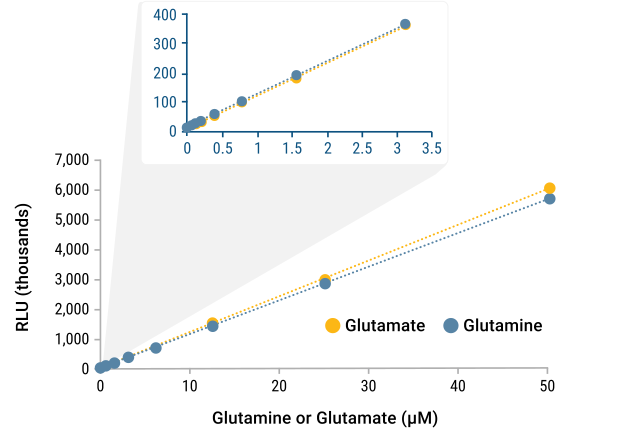
Glutamine and Glutamate Titration Curves
Advantages
Quickly Measure Metabolites in a Variety of Sample Types: Measure in media, cells, tissue and plasma. The assays require minimal preparation steps with no need for centrifugation and spin columns.
Conduct easy in-well processing for intracellular detection.
Measure Across a Wide Range of Concentrations: Broad linearity up to 3 logs enables simple sample measurement.
Detect Small Changes: Wide assay window with S/Bmax > 300 allows better discrimination of small changes in metabolite levels compared to colorimetric and fluorometric assays.
Gain More Information Per Sample: The assays are amenable to measuring multiple metabolites from the same sample. Multiplex with cell viability assays for normalization.
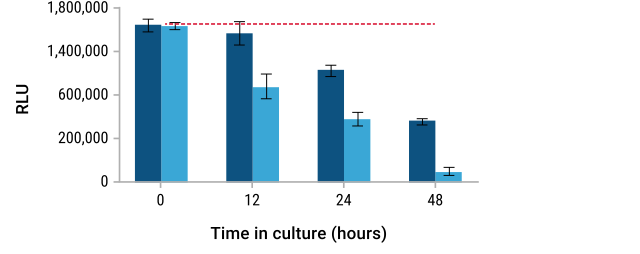
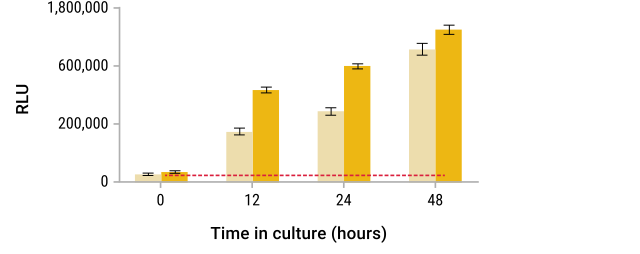
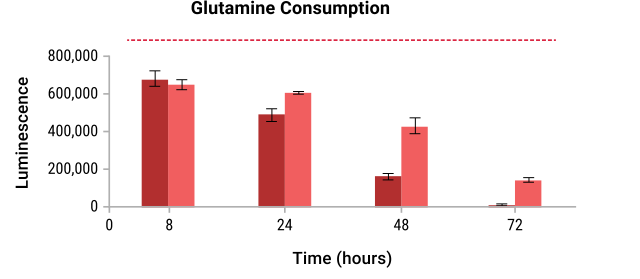
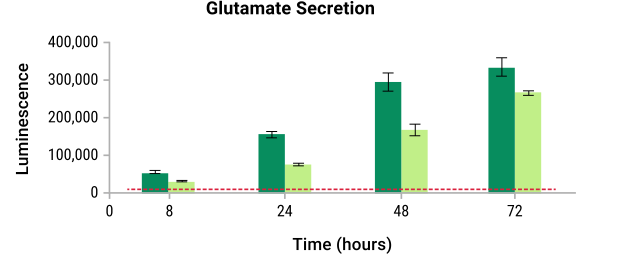
Glutamine Consumption and Glutamate Secretion by SKOV-3 Cells
Measure Multiple Metabolites from One Sample
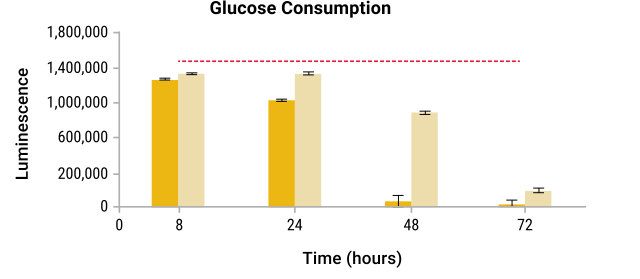
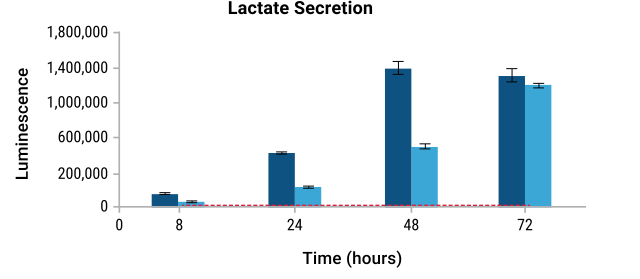
Easily measure changes in cellular glycolysis and glutaminolysis by sampling medium over time. Direct measurement of four metabolites important to the energetic state of the cell—glucose, lactate, glutamate and glutamine—can be performed in parallel using the bioluminescent Glucose-Glo™, Lactate-Glo™, Glutamine/Glutamate-Glo™ and Glutamate-Glo™ Assays. No specialized instrument, plates or artificial medium is required. Sample processing compatible with all of the bioluminescent metabolite assays means the same sample can be used for detecting all four metabolites. This includes sample types such as culture medium, serum, plasma and tissue. The data below were produced by measuring metabolites using medium samples from the same cell cultures as described in Technical Manual TM494.
Protocols
Complete Protocol
Specifications
Catalog Number:
Contenido
| Item | Part # | Presentación | Concentración |
|---|---|---|---|
Reductase |
G884A | 1 × 55μl | 6mg/ml |
Reductase Substrate |
G885A | 1 × 55μl | |
Luciferin Detection Solution |
J135A | 1 × 5ml | |
NAD |
J136B | 1 × 275μl | |
Glutamate |
J139A | 1 × 50μl | |
Glutamate Dehydrogenase |
J141A | 1 × 100μl | |
Glutaminase |
J142A | 1 × 25μl | |
Glutaminase Buffer |
J143A | 1 × 2.5ml |
SDS
Search for SDSCertificado de Análisis
Use Restrictions
For Research Use Only. Not for Use in Diagnostic Procedures.Condiciones de Almacenaje
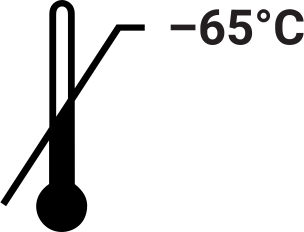
U.S. Pat. Nos. 9,273,343 and 9,951,372, European Pat. No. 2751089, Japanese Pat. No. 6067019 and other patents pending.
Contenido
| Item | Part # | Presentación | Concentración |
|---|---|---|---|
Reductase |
G884B | 1 × 275μl | 6mg/ml |
Reductase Substrate |
G885B | 1 × 275μl | |
Luciferin Detection Solution |
J135B | 1 × 50ml | |
NAD |
J136C | 1 × 1ml | |
Glutamate |
J139A | 1 × 50μl | |
Glutamate Dehydrogenase |
J141B | 1 × 1ml | |
Glutaminase |
J142B | 1 × 125μl | |
Glutaminase Buffer |
J143B | 1 × 25ml |
SDS
Search for SDSCertificado de Análisis
Use Restrictions
For Research Use Only. Not for Use in Diagnostic Procedures.Condiciones de Almacenaje
U.S. Pat. Nos. 9,273,343 and 9,951,372, European Pat. No. 2751089, Japanese Pat. No. 6067019 and other patents pending.
Resources
No related resources available
Related Products
Productos Similares
BCAA-Glo™ Assay
Método rápido y sensible para la detección de aminoácidos de cadena ramificada (BCAA) basado en tecnología bioluminiscente.
JE9300, JE9400
Lactate-Glo™ Assay
Ensayo bioluminiscente que detecta rápidamente el lactato a partir de diversos tipos de muestras.
J5021, J5022
Glutamate-Glo™ Assay
Mide rápidamente el glutamato a partir de muchos tipos de muestras.
J7021, J7022
Triglyceride-Glo™ Assay
Detecta los niveles de triglicéridos midiendo el glicerol que se libera de una reacción enzimática con una lipasa.
J3160, J3161
Usado con frecuencia junto con
CellTiter-Glo® 2.0 Cell Viability Assay
Versión actualizada del CellTiter-Glo® Cell Viability Assay con una estabilidad del reactivo mejorada. Cuantifica la proliferación celular basándose en la detección de ATP.
G9241, G9242, G9243
GloMax® Discover System
Lector de microplacas de alto rendimiento para la detección de luminiscencia, fluorescencia y absorbancia.
GM3000
RealTime-Glo™ MT Cell Viability Assay
Método bioluminiscente que permite monitorizar la cinética de viabilidad de cultivos celulares durante 72 horas.
G9711, G9712, G9713