Metabolite-Glo™ Detection System
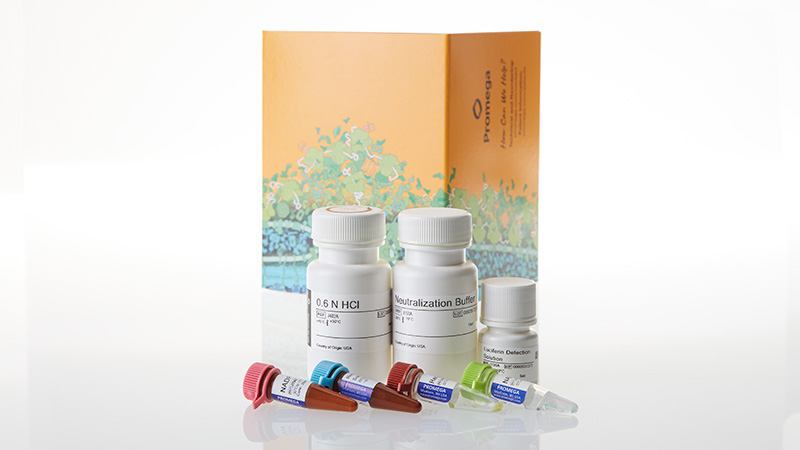
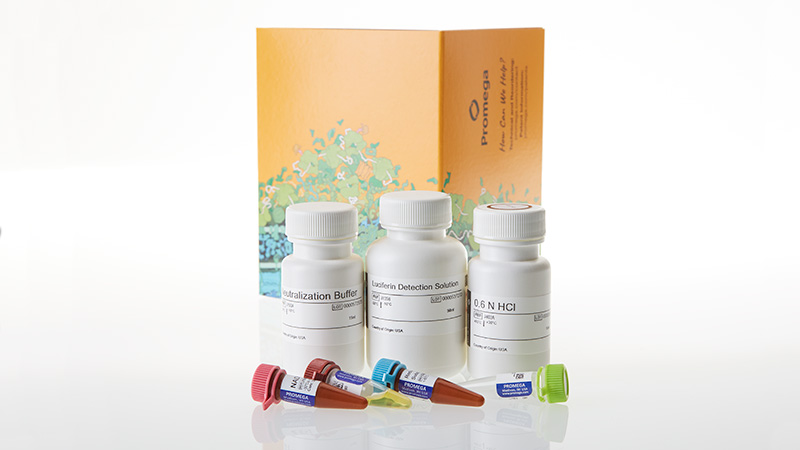
Easy Metabolite Detection Customizable to Your Specific Targets
- Bioluminescent NAD(P)H detection toolkit that can be coupled with a metabolite-specific dehydrogenase to build custom metabolite detection assays
- For use with cultured cells, media samples, tissue homogenates and serum samples
- Scalable to 384-well format for HTS applications

Catalog Number:
Size
Catalog Number: J9030
Catalog Number: J9040
Simple Detection of Metabolites from Diverse Samples
The Metabolite-Glo™ Detection System is a rapid and sensitive approach for detecting NAD(P)H in a variety of biological samples, including cultured cells, media samples, tissue homogenates and serum. This system can be optimized to detect specific metabolites by coupling NAD(P)H detection with a suitable dehydrogenase enzyme (which must be obtained separately). We provide straightforward instructions for metabolite assay development and optimization in the technical manual.
The Metabolite-Glo™ System provides reagents for a streamlined sample preparation with acid treatment and neutralization steps performed directly in the assay wells. This eliminates the need for traditional methods such as cell collection, centrifugation and spin columns. With its sensitive detection capabilities and liquid formulation, the assay is easily adapted to a high-throughput 384-well format, enabling the efficient analysis of numerous samples simultaneously.
How the Metabolite-Glo™ Detection System Works
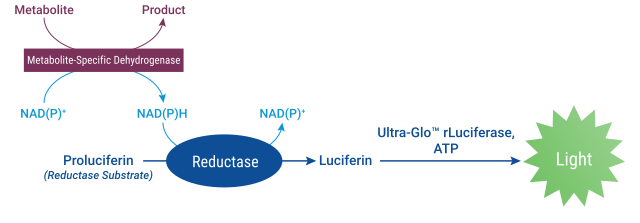
The core technology provided in the Metabolite-Glo™ Detection System measures NAD(P)H. To measure a metabolite of interest using this system, you need to identify and source a metabolite-specific dehydrogenase. The dehydrogenase couples metabolite oxidation to NAD(P)+ reduction. The reduced dinucleotides, NAD(P)H, are measured using a luciferase reaction. The amount of light produced by luciferase is proportional to the amount of metabolite in the sample.
Save Time with a Simple Add-and-Read Protocol
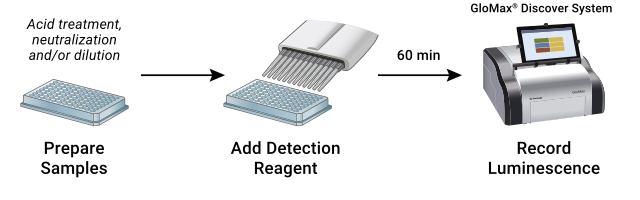
Reagents for in-well sample preparation are included in the Metabolite-Glo™ Detection System to streamline your workflow and reduce variability.
Accurately Detect the Smallest Changes in Metabolite Levels
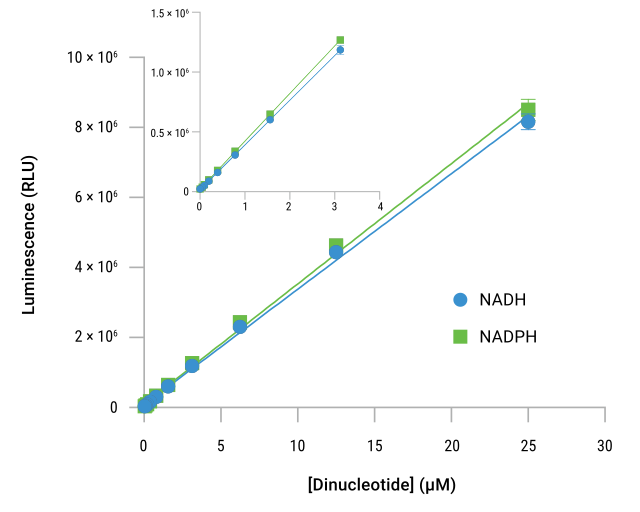
The NAD(P)H core technology does not discriminate between NADH and NAD(P)H, allowing either NAD-dependent or NADP-dependent dehydrogenases to be used for metabolite detection. The sensitivity and linearity of metabolite detection is defined by the core technology and is within 40nM–25μM.
View our portfolio of complete, ready-to-use metabolite detection kits.
Example Protocols for Metabolite Detection
Promega scientists have developed protocols that use the Metabolite-Glo™ Detection System with commercially available dehydrogenases and standards for specific metabolite detection from biological samples:
Validated Protocols for Metabolite Detection
| Metabolite | Application Note | |
|
Isocitrate |
||
Protocols
Complete Protocol
Specifications
Catalog Number:
Contenido
| Item | Part # | Presentación | Concentración |
|---|---|---|---|
Reductase |
G884A | 1 × 55μl | 6mg/ml |
Reductase Substrate |
G885A | 1 × 55μl | |
Luciferin Detection Solution |
J135A | 1 × 5ml | |
NAD |
J136B | 1 × 275μl | |
Neutralization Buffer |
J153A | 1 × 15ml | |
NADP+ |
J154B | 1 × 100μl | |
0.6N HCl |
J402A | 1 × 15ml |
SDS
Search for SDSCertificado de Análisis
Use Restrictions
For Research Use Only. Not for Use in Diagnostic Procedures.Condiciones de Almacenaje
U.S. Pat. Nos. 9,273,343 and 9,951,372, European Pat. No. 2751089, Japanese Pat. No. 6067019 and other patents pending.
Contenido
| Item | Part # | Presentación | Concentración |
|---|---|---|---|
Reductase |
G884B | 1 × 275μl | 6mg/ml |
Reductase Substrate |
G885B | 1 × 275μl | |
Luciferin Detection Solution |
J135B | 1 × 50ml | |
NAD |
J136C | 1 × 1ml | |
Neutralization Buffer |
J153A | 1 × 15ml | |
NADP+ |
J154C | 1 × 500μl | |
0.6N HCl |
J402A | 1 × 15ml |
SDS
Search for SDSCertificado de Análisis
Use Restrictions
For Research Use Only. Not for Use in Diagnostic Procedures.Condiciones de Almacenaje
U.S. Pat. Nos. 9,273,343 and 9,951,372, European Pat. No. 2751089, Japanese Pat. No. 6067019 and other patents pending.
Resources
Artículos
Related Products
Productos Similares
Pyruvate-Glo™ Assay
Método rápido y sensible para la detección de piruvato en diversas muestras biológicas.
J4051, J4052
Lactate-Glo™ Assay
Ensayo bioluminiscente que detecta rápidamente el lactato a partir de diversos tipos de muestras.
J5021, J5022
Glucose-Glo™ Assay
Detección de glucosa de forma sencilla en una amplia gama de muestras biológicas.
J6021, J6022
Dehydrogenase-Glo™ Detection System
Conjunto de herramientas de detección bioluminiscente de NAD(P)H para medir la actividad de la enzima deshidrogenasa.
J9010, J9020
Usado con frecuencia junto con
RealTime-Glo™ MT Cell Viability Assay
Método bioluminiscente que permite monitorizar la cinética de viabilidad de cultivos celulares durante 72 horas.
G9711, G9712, G9713
CellTiter-Fluor™ Cell Viability Assay
Ensayo de viabilidad celular fluorescente no lítico con capacidad multiplex.
G6080, G6081, G6082
CellTiter-Glo® 2.0 Cell Viability Assay
Versión actualizada del CellTiter-Glo® Cell Viability Assay con una estabilidad del reactivo mejorada. Cuantifica la proliferación celular basándose en la detección de ATP.
G9241, G9242, G9243
GloMax® Discover System
Lector de microplacas de alto rendimiento para la detección de luminiscencia, fluorescencia y absorbancia.
GM3000