Lumit® SARS-CoV-2 Spike RBD: hACE2 Immunoassay
No-Wash Detection of Spike (RBD) and Human ACE2 Interaction
- Detect neutralizing antibodies, peptides or small-molecule inhibitors
- No wash, transfer or immobilization steps.
- Available as early access material; learn more
- Mutant Spike RBD proteins now available.

Catalog Number:
Scalable Assay to Monitor Viral:ACE2 Interaction
The Lumit® SARS-CoV-2 Spike RBD: hACE2 Immunoassay* is a homogeneous bioluminescent assay that measures levels of interaction between SARS-CoV-2 Spike protein receptor binding domain (RBD) and human angiotensin-converting enzyme 2 (ACE2).
NanoBiT® subunits are conjugated to a pair of secondary antibodies against two different species (anti-rabbit and anti-mouse antibodies). To detect interaction between RBD and ACE2, a rabbit Fc domain-tagged RBD and a mouse Fc domain-tagged ACE2 are mixed together with SmBiT- and LgBiT-conjugated secondary antibodies (Lumit® Anti-Mouse Ab-LgBiT and Lumit® Anti-Rabbit Ab-SmBiT). Interaction of RBD and ACE2, along with binding of the Lumit® secondary antibodies to their corresponding epitopes on the Fc-domains, brings NanoBiT® subunits into proximity to form an active NanoLuc® luciferase enzyme that generates light in proportion to the amount of target protein.
Mutant rabbit Fc domain-tagged Spike RBD proteins are now available to monitor how these mutations influence the effectiveness of potential neutralizing antibodies (purified or in patient samples), peptides or small molecule inhibitors.
Learn more about the Lumit® SARS-CoV-2 Spike RBD: hACE2 Immunoassay in the 30-minute webinar "Screening for SARS-CoV-2 Spike Protein Interactions".
*For Research Use Only. Not for Use in Diagnostic Procedures.
Assay Principle
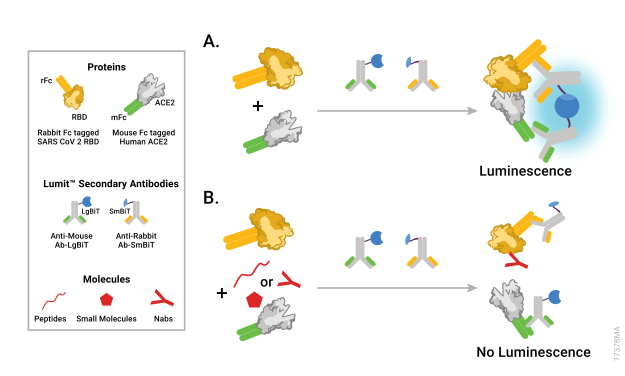
Lumit® SARS-CoV-2 Spike RBD: hACE2 Immunoassay principle. Detection of RBD-rabbit Fc:hACE2-mouse Fc interaction is performed by Lumit® secondary antibodies (Lumit® Anti-Mouse Ab-LgBiT and Lumit® Anti-Rabbit Ab-SmBiT). Panel A. Binding of the antibodies to the proteins promotes the reconstitution of NanoLuc® luciferase, generating bioluminescence. Panel B. The presence of a molecule that disrupts the RBD-hACE2 interaction reduces the bioluminescent signal.
Surrogate Neutralization Assay
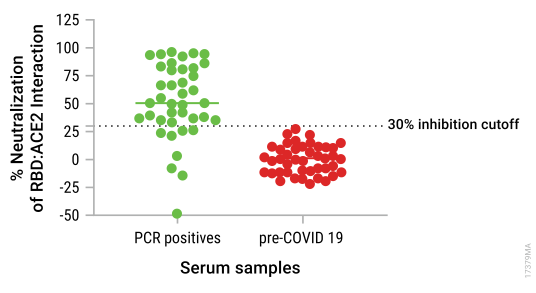
Detection of neutralizing effects of patient serum samples with the Lumit® SARS-CoV-2 Spike RBD: hACE2 Immunoassay. PCR-positive (n = 40) and pre-pandemic (n = 43) patient serum samples were incubated with 1.5nM of each of SARS-CoV-2 RBD (Rabbit Fc), hACE2 (Mouse Fc) and Lumit® Antibody Mix. After a 1 hour incubation at 23°C, 12.5μl Lumit® Detection Reagent was added, followed by incubation at room temperature for 30 minutes. Luminescence was recorded using a GloMax® Discover Microplate Luminometer (Cat.# GM3000). Net luminescence values of all samples were converted to percentage PPI activity using the “Lumit Reagents Only” and “Pre-COVID19 negative serum” controls as 0% and 100%, respectively. Sample percent neutralization was calculated as [100 – % PPI activity]. The dotted line represents the cutoff of at 30% neutralization/inhibition.
Evaluation of Antibody Neutralization Levels on Major SARS-CoV-2 RBD Mutant Variants
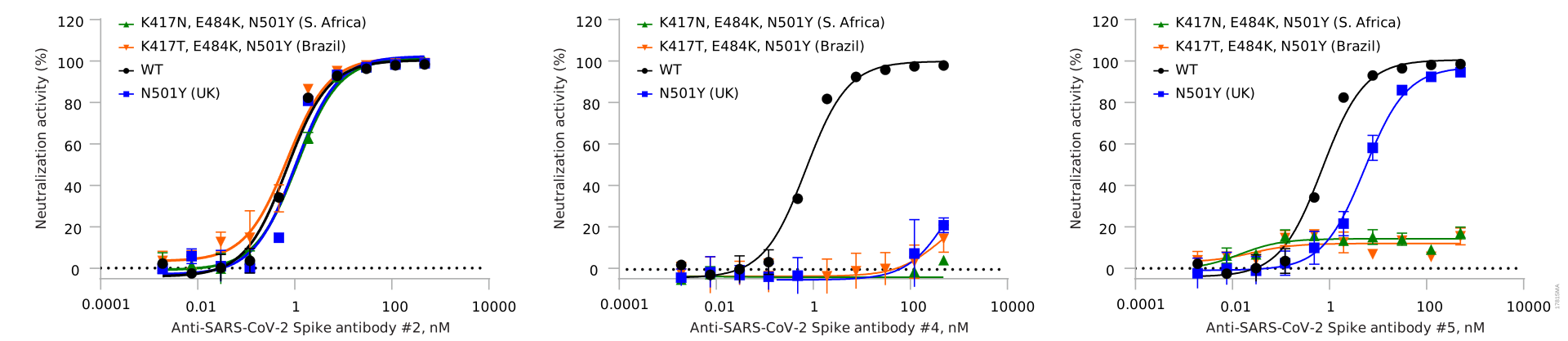
Antibody titrations with wild-type RBD-Fc and variants containing the E484K, K417N, K417T and N501Y mutations. Monoclonal anti-SARS-CoV-2 RBD antibodies were serially diluted and incubated with wild-type and the major mutant variants of RBD-Fc for 30 minutes prior to the addition of hACE2-Fc and Lumit® antibodies. Different antibody selectivity patterns were observed with RBD-Fc mutants. Mutations can confer some antibody inhibition escape to RBD. Some antibodies can still inhibit the mutant RBD interaction with ACE2 similar to WT.
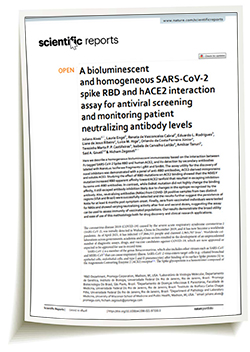
See More Data: This peer-reviewed paper, published in Nature Communications Biology, shows how the Lumt™ SARS-CoV-2 Spike RBD: hACE2 Immunoassay assay can be used to discover novel inhibitors that block the binding of SARS-CoV-2 to human ACE2, and to study how mutations in the SARS-CoV-2 spike protein alter its apparent affinity for human ACE2. The paper also details studies where the assay was used to detect the presence of neutralizing antibodies from COVID-19-positive samples and samples from vaccinated individuals.
Protocols
No protocols available
Specifications
Catalog Number:
Resources
No related resources available
Related Products
No related products available