Minimal Promoter-Driven NanoLuc® Genetic Reporter Vectors
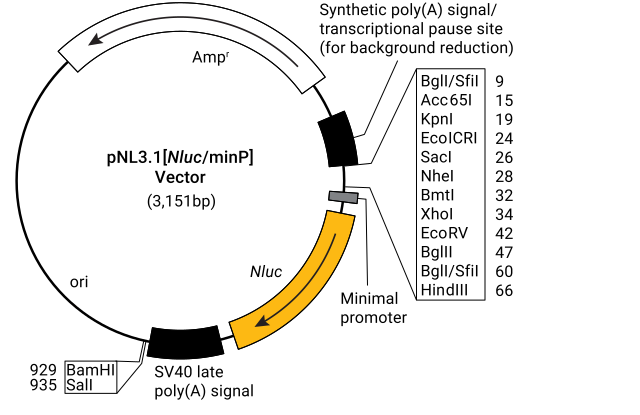
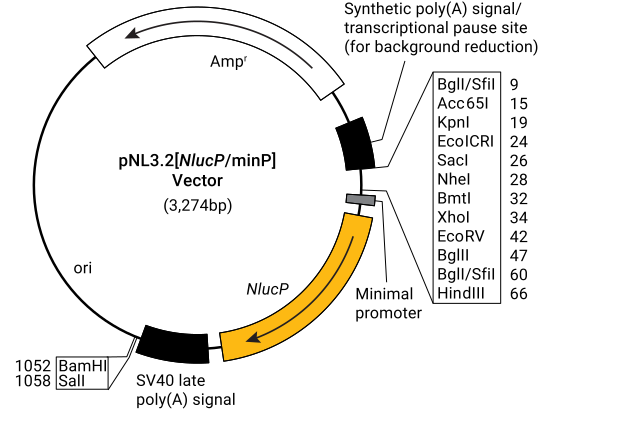
Clone Response Elements of Interest to Drive Expression of NanoLuc® Luciferase
- Nluc genes are codon optimized for mammalian cells
- Many potential regulatory elements or other undesirable features have been removed (such as common restriction enzyme sites)
- Vectors have a pGL4-based backbone for easy sequence transfer from existing plasmids

Catalog Number:
Choose a luciferase gene
Size
Catalog Number: N1031
Catalog Number: N1041
The pNL3.1[Nluc/minP] and pNL3.2[NlucP/minP] Vectors offer a minimal promoter for cloning response elements of interest to drive expression of the bright NanoLuc® luciferase protein.
NanoLuc® (Nluc) luciferase is a small enzyme (19.1kDa) engineered for optimal performance as a luminescent reporter. The enzyme is about 100-fold brighter than either firefly (Photinus pyralis) or Renilla reniformis luciferase using a novel substrate, furimazine, to produce high intensity, glow-type luminescence. The luminescent reaction is ATP-independent and designed to suppress background luminescence for maximal assay sensitivity.
Applications
- Transcription regulation.
- Virus-cell interactions.
- Compound screening.
- Post-translational modifications.
- GPCR signaling.
- Cell signaling.
- Promoter analysis.
About NanoLuc® Luciferase and the pNL Vectors
For use as a genetic reporter, multiple forms of NanoLuc® luciferase have been configured to meet differing experimental objectives. Unfused Nluc offers maximal light output and sensitivity, and NanoLuc®-PEST (NlucP) closely couples protein expression to changes in transcriptional activity and increased signal-to background ratios. When a secreted reporter is preferred, there is NanoLuc® luciferase fused to an N-terminal secretion signal (secNluc). Luminescence is linearly proportional to the amount of NanoLuc® protein over a 1,000,000-fold concentration range, with a signal half-life ≥2 hours when detected with Nano-Glo® Luciferase Assay Reagent.
NanoLuc® luciferase possesses a number of physical properties that make it an excellent reporter protein:
- very small, monomeric enzyme (171 amino acids; 513bp)
- high thermal stability (Tm = 60°C)
- active over a broad pH range (pH 6–8)
- no post-translational modifications or disulfide bonds
- uniform distribution in cells
- emission spectrum well suited for bioluminescence resonance energy transfer (BRET; λmax = 465nM).
NanoLuc® luciferase is made available in a variety of plasmids designed for use in reporter gene assays of transcriptional control and with each of the NanoLuc® forms (unfused Nluc, PEST destabilized NlucP, and secreted secNluc). The different pNL variations are designed for the following:
- pNL1: cloning of a known or putative promoter region
- pNL2: cloning of a known or putative promoter region and establishment of a stable cell line through Hygromycin selection
- pNL3: cloning of a binding site or response element not in need of a basic promoter (such as are present in the pNL3.2.NF-κB-RE vector)
- Control plasmids for the unfused, PEST-destabilized and secreted Nluc forms also are available.
The pNL vector series uses a pGL4-based backbone for easy sequence transfer from existing plasmids. This backbone design also reduces anomalous results by removing many transcription factor binding sites and other potential regulatory elements. The Nluc gene variations are codon optimized and have had many potential regulatory elements or other undesirable features removed (such as common restriction enzyme sites).
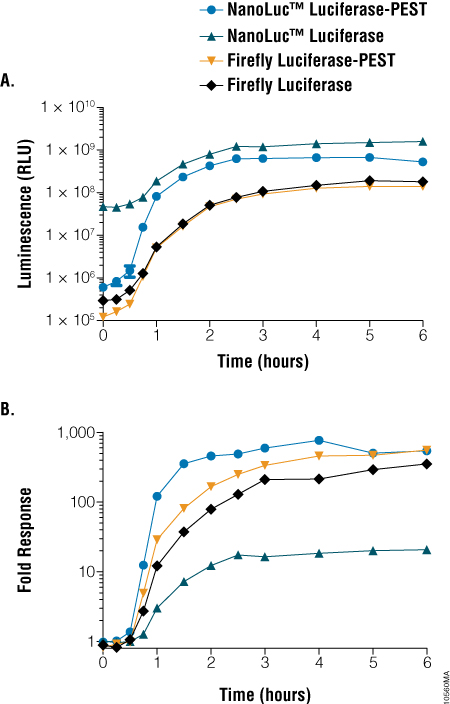
A comparison of light output and response dynamics between NanoLuc® and firefly luciferase constructs.
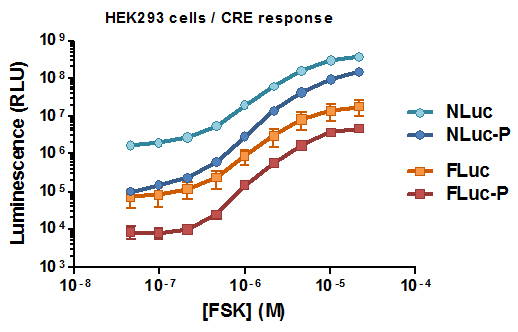
NanoLuc® Technology performs similarly to firefly luciferase but gives higher light output.
Protocols
No protocols available
Specifications
Catalog Number:
Contenido
| Item | Part # | Presentación |
|---|---|---|
| pNL3.1[Nluc/minP] Vector | N103A | 1 × 20μg |
SDS
Search for SDSCertificado de Análisis
Use Restrictions
For Research Use Only. Not for Use in Diagnostic Procedures.Condiciones de Almacenaje
NanoLuc® Luciferase Limited Use Label License
BY USE OF THIS PRODUCT, RESEARCHER AGREES TO BE BOUND BY THE TERMS OF THIS LIMITED USE LABEL LICENSE. If researcher is not willing to accept the conditions of this limited use statement, and the product is unused, Promega will accept return of the unused product and provide researcher with a full refund.
Researchers may use this product for research use only; no transfer or commercial use of this product is allowed. Commercial use means any and all uses of this product or derivatives by a party in exchange for consideration, including, but not limited to (1) use in further product manufacture; (2) use in provision of services, information or data; and (3) resale of the product or its derivatives, whether or not such product or derivatives are resold for use in research. Researchers shall have no right to modify or otherwise create variations of the nucleotide sequence of the luciferase gene except that researcher may (1) create fused gene sequences provided that the coding sequence of the resulting luciferase gene has no more than four deoxynucleotides missing at the affected terminus compared to the intact luciferase gene sequence; and (2) insert and remove nucleic acid sequences in splicing research predicated on the inactivation or reconstitution of the luminescence of the encoded luciferase. No other use of this product or derivatives is authorized without the prior express written consent of Promega.
In addition, researchers must:
(1a) use Nano-Glo®-branded luminescent assay reagents (LARs) for all determinations of luminescence activity of this product and its derivatives; or
(1b) contact Promega to obtain a license for use of the product and its derivatives with LARs not manufactured by Promega.
For uses of Nano-Glo®-branded LARs intended for energy transfer (such as bioluminescence resonance energy transfer) to acceptors other than a genetically encoded autofluorescent protein, researchers must:
(2a) use NanoBRET®-branded energy acceptors (e.g., BRET-optimized HaloTag® ligands) for all determinations of energy transfer activity by this product and its derivatives; or
(2b) contact Promega to obtain a license for use of the product and its derivatives for energy transfer assays to energy acceptors not manufactured by Promega.
Researchers may transfer derivatives to others for research use provided that at the time of transfer a copy of this label license is given to the recipients and recipients agree to be bound by the terms of this label license. With respect to any uses outside this label license, including any diagnostic, therapeutic, prophylactic or commercial uses, please contact Promega for supply and licensing information. PROMEGA MAKES NO REPRESENTATIONS OR WARRANTIES OF ANY KIND, EITHER EXPRESSED OR IMPLIED, INCLUDING FOR MERCHANTABILITY OR FITNESS FOR A PARTICULAR PURPOSE, WITH REGARD TO THE PRODUCT. The terms of this agreement shall be governed under the laws of the State of Wisconsin, USA.
U.S. Pat. Nos. 8,557,970, 8,669,103, 9,777,311, 9,840,730, 9,951,373, 10,233,485, 10,633,690, 10,774,364, 10,844,422, 11,365,436, 11,661,623, 11,667,950; European Pat. Nos. 2456864, 2635595, 2990478, 3181687, 3409764; Japanese Pat. Nos. 6038649, 6155424, 6227615, 6374420, 6539689; and other patents and patents pending.
Contenido
| Item | Part # | Presentación |
|---|---|---|
| pNL3.2[NlucP/minP] Vector | N104A | 1 × 20μg |
SDS
Search for SDSCertificado de Análisis
Use Restrictions
For Research Use Only. Not for Use in Diagnostic Procedures.Condiciones de Almacenaje
NanoLuc® Luciferase Limited Use Label License
BY USE OF THIS PRODUCT, RESEARCHER AGREES TO BE BOUND BY THE TERMS OF THIS LIMITED USE LABEL LICENSE. If researcher is not willing to accept the conditions of this limited use statement, and the product is unused, Promega will accept return of the unused product and provide researcher with a full refund.
Researchers may use this product for research use only; no transfer or commercial use of this product is allowed. Commercial use means any and all uses of this product or derivatives by a party in exchange for consideration, including, but not limited to (1) use in further product manufacture; (2) use in provision of services, information or data; and (3) resale of the product or its derivatives, whether or not such product or derivatives are resold for use in research. Researchers shall have no right to modify or otherwise create variations of the nucleotide sequence of the luciferase gene except that researcher may (1) create fused gene sequences provided that the coding sequence of the resulting luciferase gene has no more than four deoxynucleotides missing at the affected terminus compared to the intact luciferase gene sequence; and (2) insert and remove nucleic acid sequences in splicing research predicated on the inactivation or reconstitution of the luminescence of the encoded luciferase. No other use of this product or derivatives is authorized without the prior express written consent of Promega.
In addition, researchers must:
(1a) use Nano-Glo®-branded luminescent assay reagents (LARs) for all determinations of luminescence activity of this product and its derivatives; or
(1b) contact Promega to obtain a license for use of the product and its derivatives with LARs not manufactured by Promega.
For uses of Nano-Glo®-branded LARs intended for energy transfer (such as bioluminescence resonance energy transfer) to acceptors other than a genetically encoded autofluorescent protein, researchers must:
(2a) use NanoBRET®-branded energy acceptors (e.g., BRET-optimized HaloTag® ligands) for all determinations of energy transfer activity by this product and its derivatives; or
(2b) contact Promega to obtain a license for use of the product and its derivatives for energy transfer assays to energy acceptors not manufactured by Promega.
Researchers may transfer derivatives to others for research use provided that at the time of transfer a copy of this label license is given to the recipients and recipients agree to be bound by the terms of this label license. With respect to any uses outside this label license, including any diagnostic, therapeutic, prophylactic or commercial uses, please contact Promega for supply and licensing information. PROMEGA MAKES NO REPRESENTATIONS OR WARRANTIES OF ANY KIND, EITHER EXPRESSED OR IMPLIED, INCLUDING FOR MERCHANTABILITY OR FITNESS FOR A PARTICULAR PURPOSE, WITH REGARD TO THE PRODUCT. The terms of this agreement shall be governed under the laws of the State of Wisconsin, USA.
U.S. Pat. Nos. 8,557,970, 8,669,103, 9,777,311, 9,840,730, 9,951,373, 10,233,485, 10,633,690, 10,774,364, 10,844,422, 11,365,436, 11,661,623, 11,667,950; European Pat. Nos. 2456864, 2635595, 2990478, 3181687, 3409764; Japanese Pat. Nos. 6038649, 6155424, 6227615, 6374420, 6539689; and other patents and patents pending.
Resources
No related resources available
Related Products
Productos Similares
Minimal Promoter-Driven Firefly Luciferase Vectors
Tres vectores reporteros que permiten clonar un elemento de respuesta upstream de interés de un promotor mínimo y del gen de la luciferasa firefly.
E8411, E8421, E8431
Promoter-Driven Control NanoLuc® Luciferase Vectors
Tres vectores reporteros NanoLuc® con promotor CMV, PGK o TK. Co-transfección con vectores de luciferasa firefly para la normalización en ensayos de doble reportero.
N1441, N1501, N1091
Promoterless NanoLuc® Reporter Basic Vectors
Dos vectores reporteros que permiten clonar regiones promotoras putativas para expresar la NanoLuc® Luciferase con diferentes vidas medias.
N1001, N1011
Secreted NanoLuc® Reporter Vectors
Cuatro vectores con una NanoLuc® Luciferase secretada y varias configuraciones de promotores para la expresión en células de mamífero.
N1021, N1051, N1081, N1101
Usado con frecuencia junto con
Nano-Glo® Luciferase Assay System
Ensayo "add-mix-measure" de NanoLuc® Luciferase con >2 horas de vida media en la mayoría de las aplicaciones.
N1110, N1120, N1130, N1150
FuGENE® HD Transfection Reagent
Rendimiento mejorado en una amplia gama de tipos celulares, incluidas líneas celulares difíciles de transfectar.
E2311, E2312
Wizard® SV Gel and PCR Clean-Up System
Purifica fragmentos de ADN a partir de secciones de gel o de reacciones PCR, en tan sólo 15 minutos.
A9281, A9282, A9285, A9283, A9284
LigaFast™ Rapid DNA Ligation System
Efficiently ligates sticky-ended DNA inserts into plasmid vectors in just 5 minutes at room temperature (blunt-ended inserts in as little as 15 minutes).
M8221, M8225