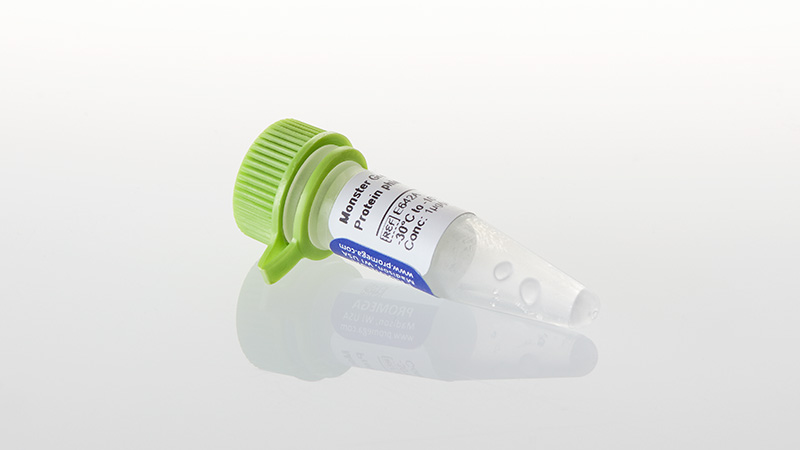
Monster Green® Fluorescent Protein phMGFP Vector
Improved Synthetic GFP Reporter with Greater Fluorescent Intensity and Reduced Cytotoxicity
- Visualize low-level expression in situ using fluorescence microscopy, imagers or FACS®
- Create fusion proteins for imaging and localization studies using standard FITC detection
- Transfect at high efficiencies for precloning confirmation studies

Catalog Number:
Size
Catalog Number: E6421
The phMGFP Vector contains the open reading frame for the Monster Green® Fluorescent Protein cloned into a mammalian expression vector. The Monster Green® Fluorescent Protein is encoded by an improved synthetic version of the green fluorescent protein gene originally cloned from Montastrea cavernosa (Great Star Coral). The synthetic gene (hMGFP) expresses a 26kDa protein that shows improved fluorescence intensity compared to the native gene. Furthermore, the hMGFP gene has been codon optimized and cleared of most consensus sequence transcription factor binding sites to ensure reliability and high levels of expression.
The Monster Green® Fluorescent Protein encoded by the hMGFP gene is an ideal fluorescent reporter, providing high-level fluorescence and reducing cytotoxicity. Monster Green® Fluorescent Protein generally fluoresces at least 20% brighter than other commercially available green fluorescent proteins (GFPs) and also minimizes cellular perturbations, offering flexibility when working with transient and stable expression assays.
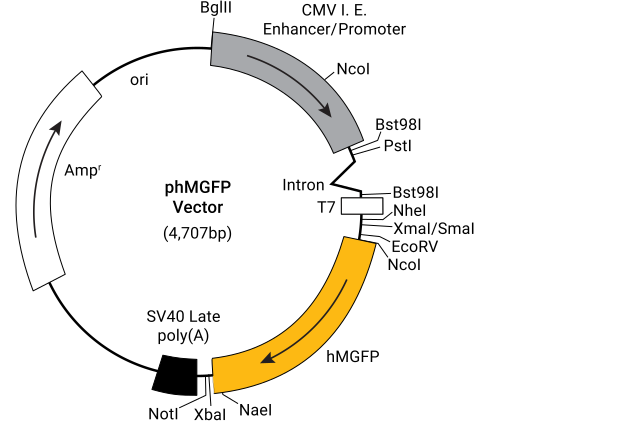
Monster Green® Fluorescent Protein phMGFP Vector GenBank® Accession Number AY218848 and vector sequence text file.
Protocols
Specifications
Catalog Number:
Contenido
| Item | Part # | Presentación |
|---|---|---|
|
Monster Green® Fluorescent Protein phMGFP Vector |
E642A | 1 × 20μg |
SDS
Search for SDSCertificado de Análisis
Use Restrictions
For Research Use Only. Not for Use in Diagnostic Procedures.Condiciones de Almacenaje

Resources
No related resources available
Related Products
Productos Similares
Promoter-Driven Control Firefly Luciferase Vectors
Tres vectores reporteros pGL4 con un promotor (SV40, PGK o TK) que se utilizan como control reportero para ensayos de doble luciferasa.
E6681, E5011, E5061
Promoter-Driven Control Renilla Luciferase Vectors
Tres vectores Renilla con un promotor diferente (SV40, TK o CMV) que pueden utilizarse como reportero de control para ensayos de doble luciferasa.
E6911, E6921, E6931
Promoter-Driven Control NanoLuc® Luciferase Vectors
Tres vectores reporteros NanoLuc® con promotor CMV, PGK o TK. Co-transfección con vectores de luciferasa firefly para la normalización en ensayos de doble reportero.
N1441, N1501, N1091
Control NanoLuc® Reporter Vector with Hygromycin Selection
Vector pNL3.2.CMV que se utiliza como control negativo para medir los cambios en los niveles de expresión de la NanoLuc® Luciferase (NlucP).
N1411
Usado con frecuencia junto con
FuGENE® HD Transfection Reagent
Rendimiento mejorado en una amplia gama de tipos celulares, incluidas líneas celulares difíciles de transfectar.
E2311, E2312
ViaFect™ Transfection Reagent
Transfección de alta eficacia y baja toxicidad de muchos tipos celulares, incluyendo las células iPS.
E4981, E4982
ProFection® Mammalian Transfection System
Método basado en el uso de fosfato cálcico para la transfección estable o transitoria de células eucariotas.
E1200