NanoLuc® Stability Sensors for Cell Signaling
Vectors to Measure Intracellular Protein Turnover of HIFA and NRF2
- Ready-to-use constructs are predesigned, optimized and tested for low endotoxin levels
- C-terminal fusion of HIF1A NanoLuc® luciferase reporter in pNLF1-HIF1A [CMV/neo] Vector
- NRF2 vector system has a pKEAP1-expressing vector for regulating intracellular NRF2 levels and pNLF1-NRF2 [CMV/neo] Vector expressing a C-terminal fusion with NanoLuc® luciferase

Catalog Number:
Choose a protein
Size
Catalog Number: N1381
Catalog Number: N1391
The rate of protein turnover is tightly regulated for many signaling proteins involved in oncogenesis and response to cellular stress. Protein stabilization and subsequent accumulation occurs in response to changing cellular conditions resulting in activation of downstream transcriptional events. The NanoLuc® Stability Sensors are ready-to-use vector systems that utilize the advantages of the NanoLuc® luciferase reporter to enable stability studies of two key signaling proteins, HIF1A and NRF2, providing a method to directly measure this primary signaling event.
HIF1A Vector System: The HIF1A Vector System enables simple quantification of intracellular HIF1A protein levels to study the dynamics of this signaling protein in mediating cellular response to hypoxia. It contains a vector encoding NanoLuc® fused to the C-terminus of the HIF1A protein under control of the CMV promoter plus Transfection Carrier DNA for titrating intracellular fusion protein expression.
NRF2 Vector System: The NRF2 Vector System enables simple quantification of intracellular NRF2 protein levels to study the dynamics of this signaling protein in mediating cellular response to oxidative stress. It contains a vector encoding NanoLuc® fused to the C-terminus of the NRF2 protein under the control of the CMV promoter, a pKEAP1-expressing vector for proper regulation of intracellular NRF2 levels and Transfection Carrier DNA for titratable intracellular fusion protein expression.
Applications
- Compound screening.
- Hypoxia signaling.
- Oxidative stress signaling.
Sequence Information
pNLF1-HIF1A [CMV/neo] Vector GenBank® Accession Number KF853601 and vector sequence text file.
pNLF1-NRF2 [CMV/neo] Vector GenBank® Accession Number KF853602 and vector sequence text file
(pKEAP1 [CMV/Hygro] Vector GenBank® Accession Number KF853604 and vector sequence text file).
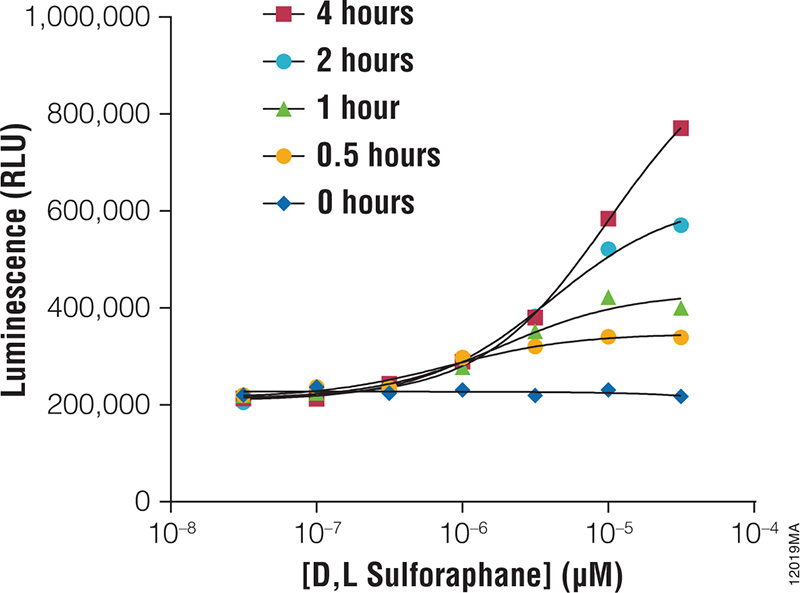
Time and dose-dependent rise of NRF2 monitored with NRF2-NanoLuc® fusion protein.
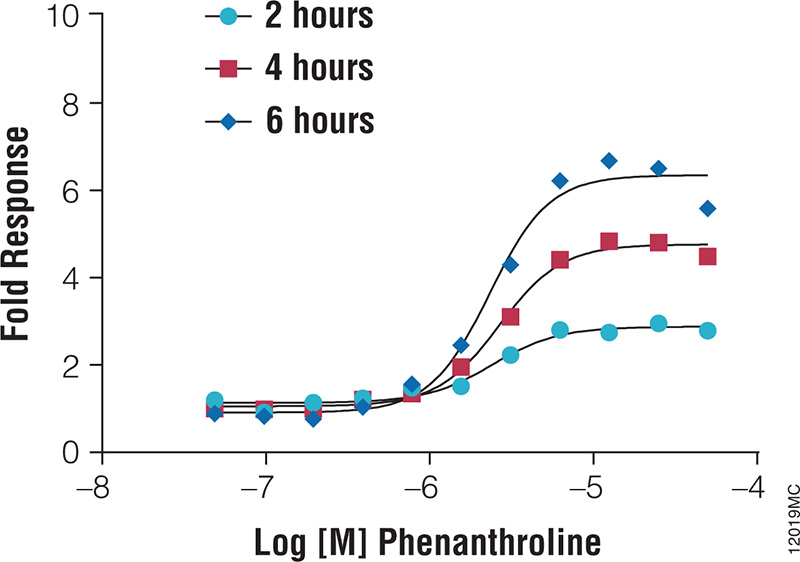
Rapid stabilization and accumulation of HIF1A monitored with HIF1A-NanoLuc® fusion protein.
Protocols
Specifications
Catalog Number:
Contenido
| Item | Part # | Presentación | Concentración | Available Separately |
|---|---|---|---|---|
Transfection Carrier DNA |
E488A | 1 × 20μg | 1μg/μl | View Product |
pNLF1-HIF1A [CMV/neo] Vector |
N138A | 1 × 20μg | 1μg/μl |
SDS
Search for SDSCertificado de Análisis
Use Restrictions
For Research Use Only. Not for Use in Diagnostic Procedures.Condiciones de Almacenaje
NanoLuc® Luciferase Limited Use Label License
BY USE OF THIS PRODUCT, RESEARCHER AGREES TO BE BOUND BY THE TERMS OF THIS LIMITED USE LABEL LICENSE. If researcher is not willing to accept the conditions of this limited use statement, and the product is unused, Promega will accept return of the unused product and provide researcher with a full refund.
Researchers may use this product for research use only; no transfer or commercial use of this product is allowed. Commercial use means any and all uses of this product or derivatives by a party in exchange for consideration, including, but not limited to (1) use in further product manufacture; (2) use in provision of services, information or data; and (3) resale of the product or its derivatives, whether or not such product or derivatives are resold for use in research. Researchers shall have no right to modify or otherwise create variations of the nucleotide sequence of the luciferase gene except that researcher may (1) create fused gene sequences provided that the coding sequence of the resulting luciferase gene has no more than four deoxynucleotides missing at the affected terminus compared to the intact luciferase gene sequence; and (2) insert and remove nucleic acid sequences in splicing research predicated on the inactivation or reconstitution of the luminescence of the encoded luciferase. No other use of this product or derivatives is authorized without the prior express written consent of Promega.
In addition, researchers must:
(1a) use Nano-Glo®-branded luminescent assay reagents (LARs) for all determinations of luminescence activity of this product and its derivatives; or
(1b) contact Promega to obtain a license for use of the product and its derivatives with LARs not manufactured by Promega.
For uses of Nano-Glo®-branded LARs intended for energy transfer (such as bioluminescence resonance energy transfer) to acceptors other than a genetically encoded autofluorescent protein, researchers must:
(2a) use NanoBRET®-branded energy acceptors (e.g., BRET-optimized HaloTag® ligands) for all determinations of energy transfer activity by this product and its derivatives; or
(2b) contact Promega to obtain a license for use of the product and its derivatives for energy transfer assays to energy acceptors not manufactured by Promega.
Researchers may transfer derivatives to others for research use provided that at the time of transfer a copy of this label license is given to the recipients and recipients agree to be bound by the terms of this label license. With respect to any uses outside this label license, including any diagnostic, therapeutic, prophylactic or commercial uses, please contact Promega for supply and licensing information. PROMEGA MAKES NO REPRESENTATIONS OR WARRANTIES OF ANY KIND, EITHER EXPRESSED OR IMPLIED, INCLUDING FOR MERCHANTABILITY OR FITNESS FOR A PARTICULAR PURPOSE, WITH REGARD TO THE PRODUCT. The terms of this agreement shall be governed under the laws of the State of Wisconsin, USA.
U.S. Pat. Nos. 8,557,970, 8,669,103, 9,777,311, 9,840,730, 9,951,373, 10,233,485, 10,633,690, 10,774,364, 10,844,422, 11,365,436, 11,661,623, 11,667,950; European Pat. Nos. 2456864, 2635595, 2990478, 3181687, 3409764; Japanese Pat. Nos. 6038649, 6155424, 6227615, 6374420, 6539689; and other patents and patents pending.
Contenido
| Item | Part # | Presentación | Concentración | Available Separately |
|---|---|---|---|---|
Transfection Carrier DNA |
E488A | 1 × 20μg | 1μg/μl | View Product |
pNLF1-NRF2 [CMV/neo] Vector |
N139A | 1 × 20μg | 1μg/μl | |
pKEAP1[CMV/Hygro] Vector |
N140A | 1 × 20μg | 1μg/μl |
SDS
Search for SDSCertificado de Análisis
Use Restrictions
For Research Use Only. Not for Use in Diagnostic Procedures.Condiciones de Almacenaje
NanoLuc® Luciferase Limited Use Label License
BY USE OF THIS PRODUCT, RESEARCHER AGREES TO BE BOUND BY THE TERMS OF THIS LIMITED USE LABEL LICENSE. If researcher is not willing to accept the conditions of this limited use statement, and the product is unused, Promega will accept return of the unused product and provide researcher with a full refund.
Researchers may use this product for research use only; no transfer or commercial use of this product is allowed. Commercial use means any and all uses of this product or derivatives by a party in exchange for consideration, including, but not limited to (1) use in further product manufacture; (2) use in provision of services, information or data; and (3) resale of the product or its derivatives, whether or not such product or derivatives are resold for use in research. Researchers shall have no right to modify or otherwise create variations of the nucleotide sequence of the luciferase gene except that researcher may (1) create fused gene sequences provided that the coding sequence of the resulting luciferase gene has no more than four deoxynucleotides missing at the affected terminus compared to the intact luciferase gene sequence; and (2) insert and remove nucleic acid sequences in splicing research predicated on the inactivation or reconstitution of the luminescence of the encoded luciferase. No other use of this product or derivatives is authorized without the prior express written consent of Promega.
In addition, researchers must:
(1a) use Nano-Glo®-branded luminescent assay reagents (LARs) for all determinations of luminescence activity of this product and its derivatives; or
(1b) contact Promega to obtain a license for use of the product and its derivatives with LARs not manufactured by Promega.
For uses of Nano-Glo®-branded LARs intended for energy transfer (such as bioluminescence resonance energy transfer) to acceptors other than a genetically encoded autofluorescent protein, researchers must:
(2a) use NanoBRET®-branded energy acceptors (e.g., BRET-optimized HaloTag® ligands) for all determinations of energy transfer activity by this product and its derivatives; or
(2b) contact Promega to obtain a license for use of the product and its derivatives for energy transfer assays to energy acceptors not manufactured by Promega.
Researchers may transfer derivatives to others for research use provided that at the time of transfer a copy of this label license is given to the recipients and recipients agree to be bound by the terms of this label license. With respect to any uses outside this label license, including any diagnostic, therapeutic, prophylactic or commercial uses, please contact Promega for supply and licensing information. PROMEGA MAKES NO REPRESENTATIONS OR WARRANTIES OF ANY KIND, EITHER EXPRESSED OR IMPLIED, INCLUDING FOR MERCHANTABILITY OR FITNESS FOR A PARTICULAR PURPOSE, WITH REGARD TO THE PRODUCT. The terms of this agreement shall be governed under the laws of the State of Wisconsin, USA.
U.S. Pat. Nos. 8,557,970, 8,669,103, 9,777,311, 9,840,730, 9,951,373, 10,233,485, 10,633,690, 10,774,364, 10,844,422, 11,365,436, 11,661,623, 11,667,950; European Pat. Nos. 2456864, 2635595, 2990478, 3181687, 3409764; Japanese Pat. Nos. 6038649, 6155424, 6227615, 6374420, 6539689; and other patents and patents pending.
Resources
No related resources available
Related Products
Productos Similares
pNLF1 NanoLuc® Protein Fusion Vectors
Tres vectores de fusión de proteínas basados en MCS que expresan fusiones N- o C-terminales con NanoLuc® Luciferase o un reportero NanoLuc® N-terminal secretado.
N1351, N1361, N1371
Stress Signaling Pathway Analysis Firefly Luciferase Vectors
Siete vectores que contienen diferentes elementos de respuesta que permiten examinar las vías de señalización impulsadas por el estrés celular.
E3641, E3651, E3661, E4131, E3751, E4001, E4121
Cytokine Signaling Pathway Analysis Firefly Luciferase Vectors
Cuatro vectores que contienen elementos de respuesta (ISRE, SIE, SBE o STAT5RE) que permiten examinar las vías de señalización de las citoquinas.
E4041, E3671, E4651, E4141
Additional Signaling Pathway Analysis Firefly Luciferase Vectors
Siete vectores con elementos de respuesta (AP1 RE, TCF-LEF RE, CRE, NFAT-RE, NF-κB-RE, SRE o SRF-RE) que permiten investigar vías de señalización.
E4111, E4611, E8471, E8481, E8491, E1340, E1350
Minimal Promoter-Driven NanoLuc® Reporter Vectors
Dos vectores que ofrecen un promotor mínimo para clonar elementos de respuesta de interés para expresar la NanoLuc® Luciferase.
N1031, N1041
Promoterless NanoLuc® Reporter Basic Vectors
Dos vectores reporteros que permiten clonar regiones promotoras putativas para expresar la NanoLuc® Luciferase con diferentes vidas medias.
N1001, N1011
Usado con frecuencia junto con
Nano-Glo® Luciferase Assay System
Ensayo "add-mix-measure" de NanoLuc® Luciferase con >2 horas de vida media en la mayoría de las aplicaciones.
N1110, N1120, N1130, N1150
Nano-Glo® Dual-Luciferase Reporter Assay System
Detección ultrasensible de la actividad luciferasa firefly y NanoLuc® en una sola muestra.
N1610, N1620, N1630, N1650, N1521, N1531, N1541, N1551
FuGENE® HD Transfection Reagent
Rendimiento mejorado en una amplia gama de tipos celulares, incluidas líneas celulares difíciles de transfectar.
E2311, E2312
GloMax® Discover System
Lector de microplacas de alto rendimiento para la detección de luminiscencia, fluorescencia y absorbancia.
GM3000